Evals / documents / Multi-step jobs
Chapters into one e-book, with its length
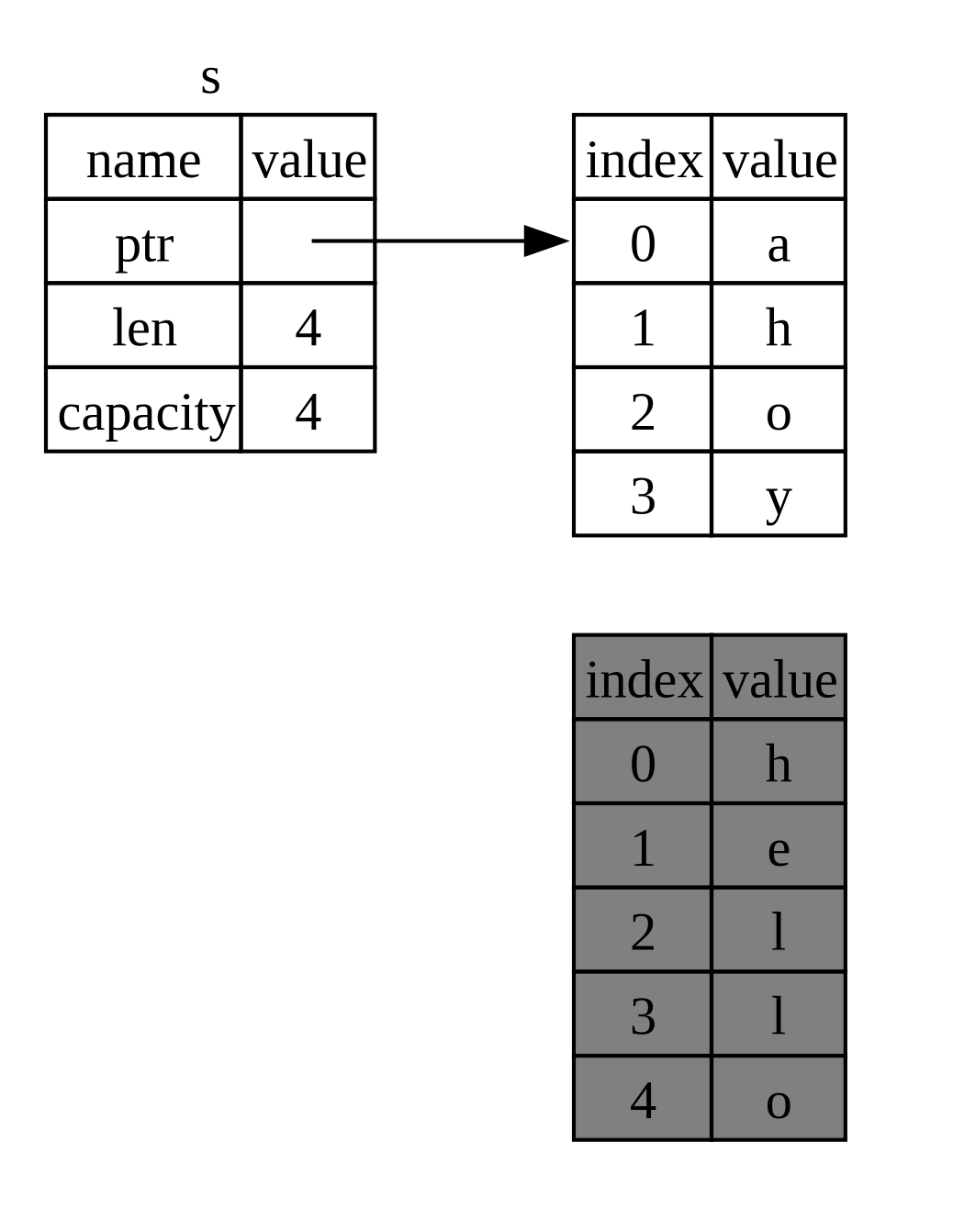
Make one e-book, ownership.epub, from the chapter files ch04-00-understanding-ownership.md, ch04-01-what-is-ownership.md, ch04-02-references-and-borrowing.md and ch04-03-slices.md, in that order, with the diagrams from img/. Then write the book's word count to words.txt.
The task
The reference answer shows the job can be done with deft. It is not an agent run.
deft md to-epub ch04-00-understanding-ownership.md ch04-01-what-is-ownership.md ch04-02-references-and-borrowing.md ch04-03-slices.md -o ownership.epub
deft epub info ownership.epub > words.txt
Input
# Understanding Ownership

Ownership is Rust’s most unique feature and has deep implications for the rest
of the language. It enables Rust to make memory safety guarantees without
needing a garbage collector, so it’s important to understand how ownership
works. In this chapter, we’ll talk about ownership as well as several related
features: borrowing, slices, and how Rust lays data out in memory.
## What Is Ownership?

_Ownership_ is a set of rules that govern how a Rust program manages memory.
All programs have to manage the way they use a computer’s memory while running.
Some languages have garbage collection that regularly looks for no-longer-used
memory as the program runs; in other languages, the programmer must explicitly
allocate and free the memory. Rust uses a third approach: Memory is managed
through a system of ownership with a set of rules that the compiler checks. If
any of the rules are violated, the program won’t compile. None of the features
of ownership will slow down your program while it’s running.

Because ownership is a new concept for many programmers, it does take some time
to get used to. The good news is that the more experienced you become with Rust
and the rules of the ownership system, the easier you’ll find it to naturally
develop code that is safe and efficient. Keep at it!

When you understand ownership, you’ll have a solid foundation for understanding
the features that make Rust unique. In this chapter, you’ll learn ownership by
working through some examples that focus on a very common data structure:
strings.

> ### The Stack and the Heap
>
> Many programming languages don’t require you to think about the stack and the
> heap very often. But in a systems programming language like Rust, whether a
> value is on the stack or the heap affects how the language behaves and why
> you have to make certain decisions. Parts of ownership will be described in
> relation to the stack and the heap later in this chapter, so here is a brief
> explanation in preparation.
>
> Both the stack and the heap are parts of memory available to your code to use
> at runtime, but they are structured in different ways. The stack stores
> values in the order it gets them and removes the values in the opposite
> order. This is referred to as _last in, first out (LIFO)_. Think of a stack of
> plates: When you add more plates, you put them on top of the pile, and when
> you need a plate, you take one off the top. Adding or removing plates from
> the middle or bottom wouldn’t work as well! Adding data is called _pushing
> onto the stack_, and removing data is called _popping off the stack_. All
> data stored on the stack must have a known, fixed size. Data with an unknown
> size at compile time or a size that might change must be stored on the heap
> instead.
>
> The heap is less organized: When you put data on the heap, you request a
> certain amount of space. The memory allocator finds an empty spot in the heap
> that is big enough, marks it as being in use, and returns a _pointer_, which
> is the address of that location. This process is called _allocating on the
> heap_ and is sometimes abbreviated as just _allocating_ (pushing values onto
> the stack is not considered allocating). Because the pointer to the heap is a
> known, fixed size, you can store the pointer on the stack, but when you want
> the actual data, you must follow the p
… 22184 more characters
## References and Borrowing

The issue with the tuple code in Listing 4-5 is that we have to return the
`String` to the calling function so that we can still use the `String` after
the call to `calculate_length`, because the `String` was moved into
`calculate_length`. Instead, we can provide a reference to the `String` value.
A reference is like a pointer in that it’s an address we can follow to access
the data stored at that address; that data is owned by some other variable.
Unlike a pointer, a reference is guaranteed to point to a valid value of a
particular type for the life of that reference.

Here is how you would define and use a `calculate_length` function that has a
reference to an object as a parameter instead of taking ownership of the value:

<Listing file-name="src/main.rs">

```rust
{{#rustdoc_include ../listings/ch04-understanding-ownership/no-listing-07-reference/src/main.rs:all}}
```

</Listing>

First, notice that all the tuple code in the variable declaration and the
function return value is gone. Second, note that we pass `&s1` into
`calculate_length` and, in its definition, we take `&String` rather than
`String`. These ampersands represent references, and they allow you to refer to
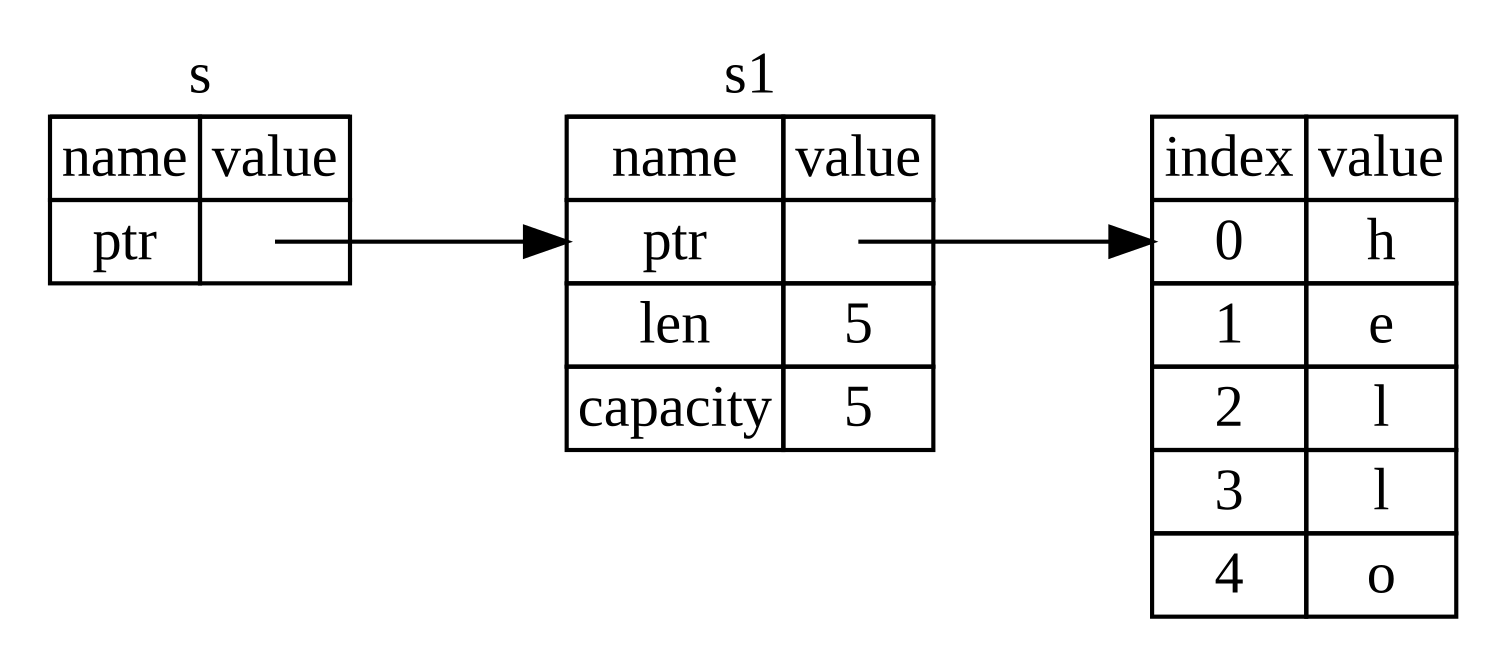
some value without taking ownership of it. Figure 4-6 depicts this concept.

<img alt="Three tables: the table for s contains only a pointer to the table
for s1. The table for s1 contains the stack data for s1 and points to the
string data on the heap." src="img/trpl04-06.svg" class="center" />

<span class="caption">Figure 4-6: A diagram of `&String` `s` pointing at
`String` `s1`</span>

> Note: The opposite of referencing by using `&` is _dereferencing_, which is
> accomplished with the dereference operator, `*`. We’ll see some uses of the
> dereference operator in Chapter 8 and discuss details of dereferencing in
> Chapter 15.

Let’s take a closer look at the function call here:

```rust
{{#rustdoc_include ../listings/ch04-understanding-ownership/no-listing-07-reference/src/main.rs:here}}
```

The `&s1` syntax lets us create a reference that _refers_ to the value of `s1`
but does not own it. Because the reference does not own it, the value it points
to will not be dropped when the reference stops being used.

Likewise, the signature of the function uses `&` to indicate that the type of
the parameter `s` is a reference. Let’s add some explanatory annotations:

```rust
{{#rustdoc_include ../listings/ch04-understanding-ownership/no-listing-08-reference-with-annotations/src/main.rs:here}}
```

The scope in which the variable `s` is valid is the same as any function
parameter’s scope, but the value pointed to by the reference is not dropped
when `s` stops being used, because `s` doesn’t have ownership. When functions
have references as parameters instead of the actual values, we won’t need to
return the values in order to give back ownership, because we never had
ownership.

We call the action of creating a reference _borrowing_. As in real life, if
… 7526 more characters## The Slice Type
_Slices_ let you reference a contiguous sequence of elements in a
[collection](ch08-00-common-collections.md)<!-- ignore -->. A slice is a kind
of reference, so it does not have ownership.
Here’s a small programming problem: Write a function that takes a string of
words separated by spaces and returns the first word it finds in that string.
If the function doesn’t find a space in the string, the whole string must be
one word, so the entire string should be returned.
> Note: For the purposes of introducing slices, we are assuming ASCII only in
> this section; a more thorough discussion of UTF-8 handling is in the
> [“Storing UTF-8 Encoded Text with Strings”][strings]<!-- ignore --> section
> of Chapter 8.
Let’s work through how we’d write the signature of this function without using
slices, to understand the problem that slices will solve:
```rust,ignore
fn first_word(s: &String) -> ?
```
The `first_word` function has a parameter of type `&String`. We don’t need
ownership, so this is fine. (In idiomatic Rust, functions do not take ownership
of their arguments unless they need to, and the reasons for that will become
clear as we keep going.) But what should we return? We don’t really have a way
to talk about *part* of a string. However, we could return the index of the end
of the word, indicated by a space. Let’s try that, as shown in Listing 4-7.
<Listing number="4-7" file-name="src/main.rs" caption="The `first_word` function that returns a byte index value into the `String` parameter">
```rust
{{#rustdoc_include ../listings/ch04-understanding-ownership/listing-04-07/src/main.rs:here}}
```
</Listing>
Because we need to go through the `String` element by element and check whether
a value is a space, we’ll convert our `String` to an array of bytes using the
`as_bytes` method.
```rust,ignore
{{#rustdoc_include ../listings/ch04-understanding-ownership/listing-04-07/src/main.rs:as_bytes}}
```
Next, we create an iterator over the array of bytes using the `iter` method:
```rust,ignore
{{#rustdoc_include ../listings/ch04-understanding-ownership/listing-04-07/src/main.rs:iter}}
```
We’ll discuss iterators in more detail in [Chapter 13][ch13]<!-- ignore -->.
For now, know that `iter` is a method that returns each element in a collection
and that `enumerate` wraps the result of `iter` and returns each element as
part of a tuple instead. The first element of the tuple returned from
`enumerate` is the index, and the second element is a reference to the element.
This is a bit more convenient than calculating the index ourselves.
Because the `enumerate` method returns a tuple, we can use patterns to
destructure that tuple. We’ll be discussing patterns more in [Chapter
6][ch6]<!-- ignore -->. In the `for` loop, we specify a pattern that has `i`
for the index in the tuple and `&item` for the single byte in the tuple.
Because we get a reference to the element from `.iter().enumerate()`, we use
`&` in the pattern.
Inside the `for` l
… 10161 more characters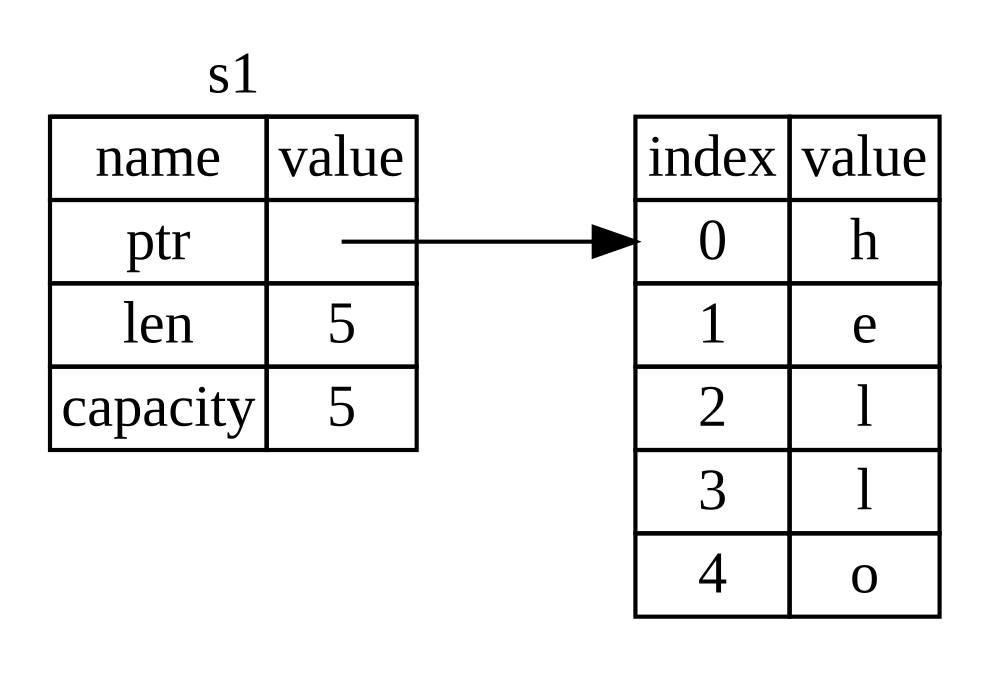
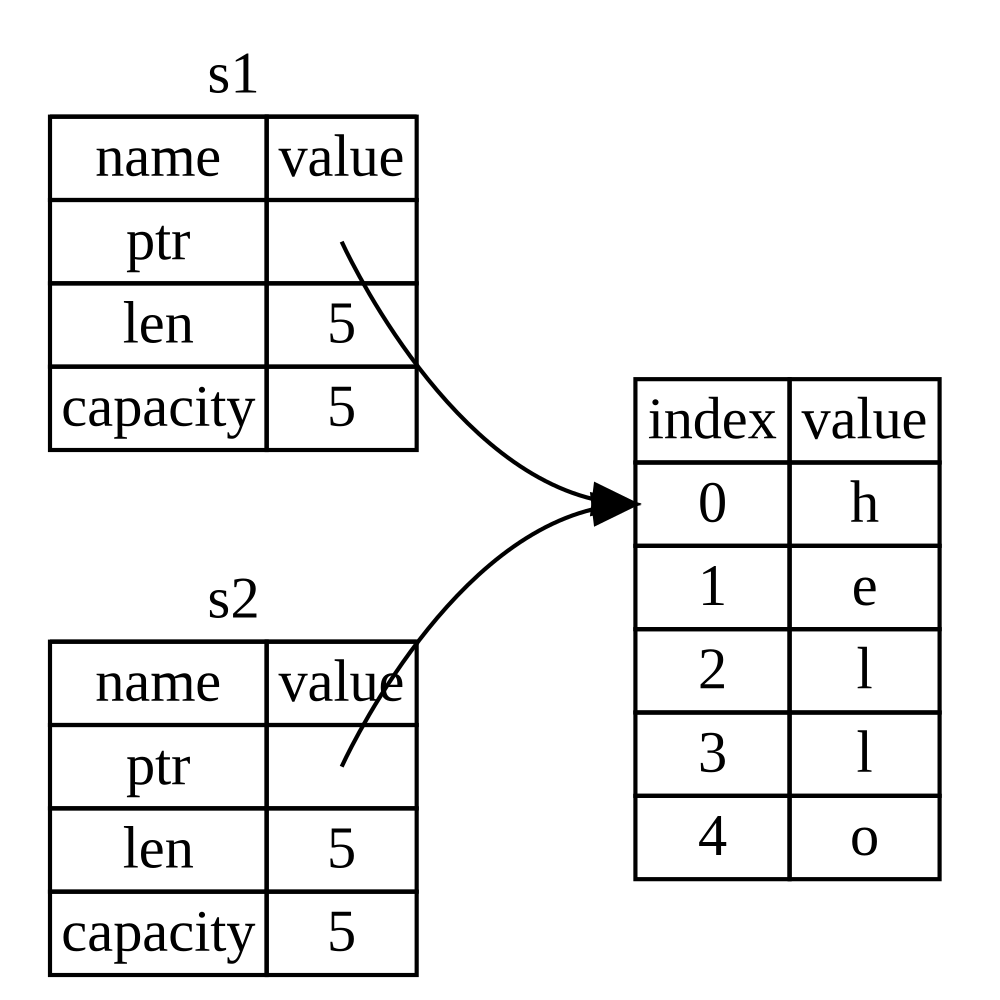
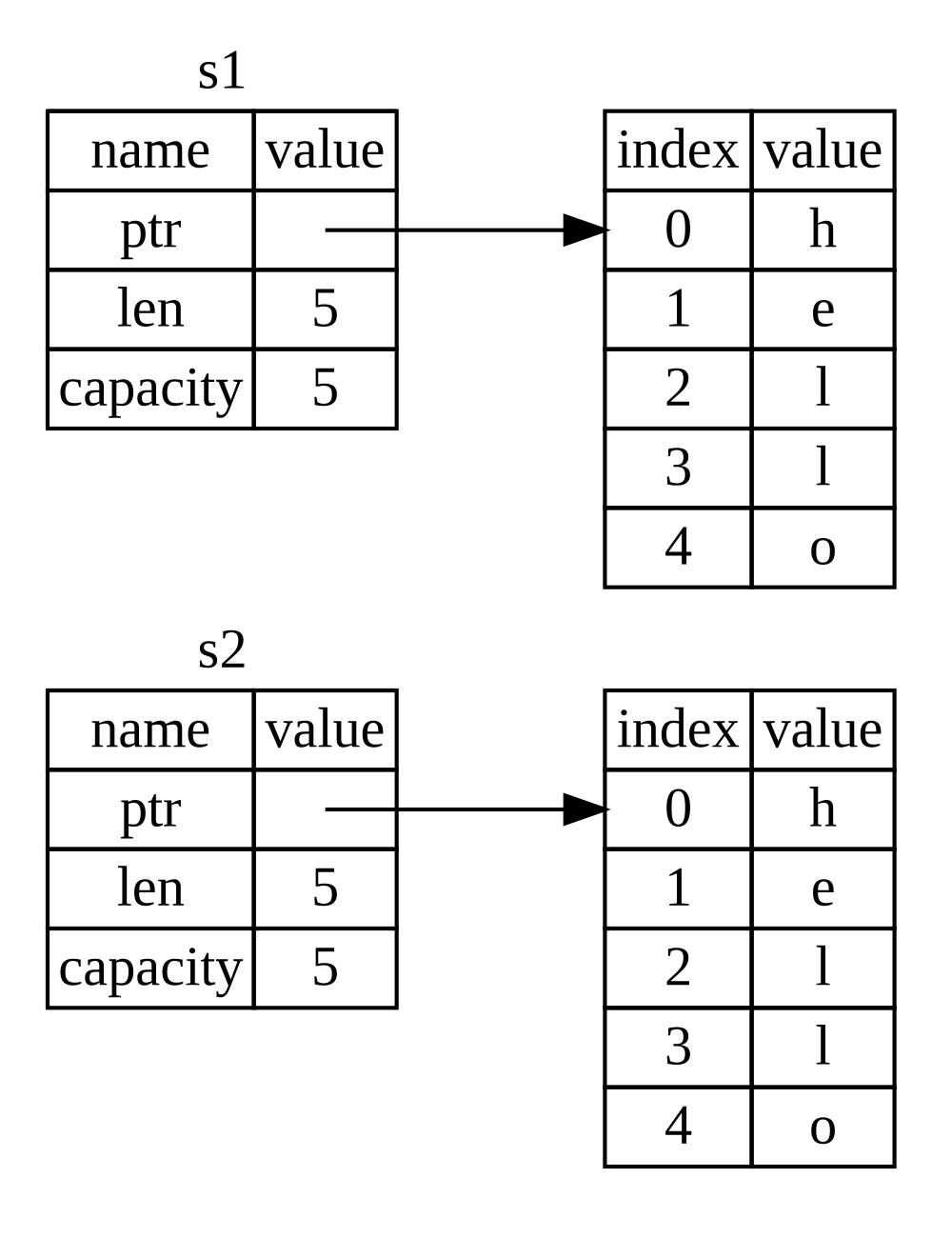
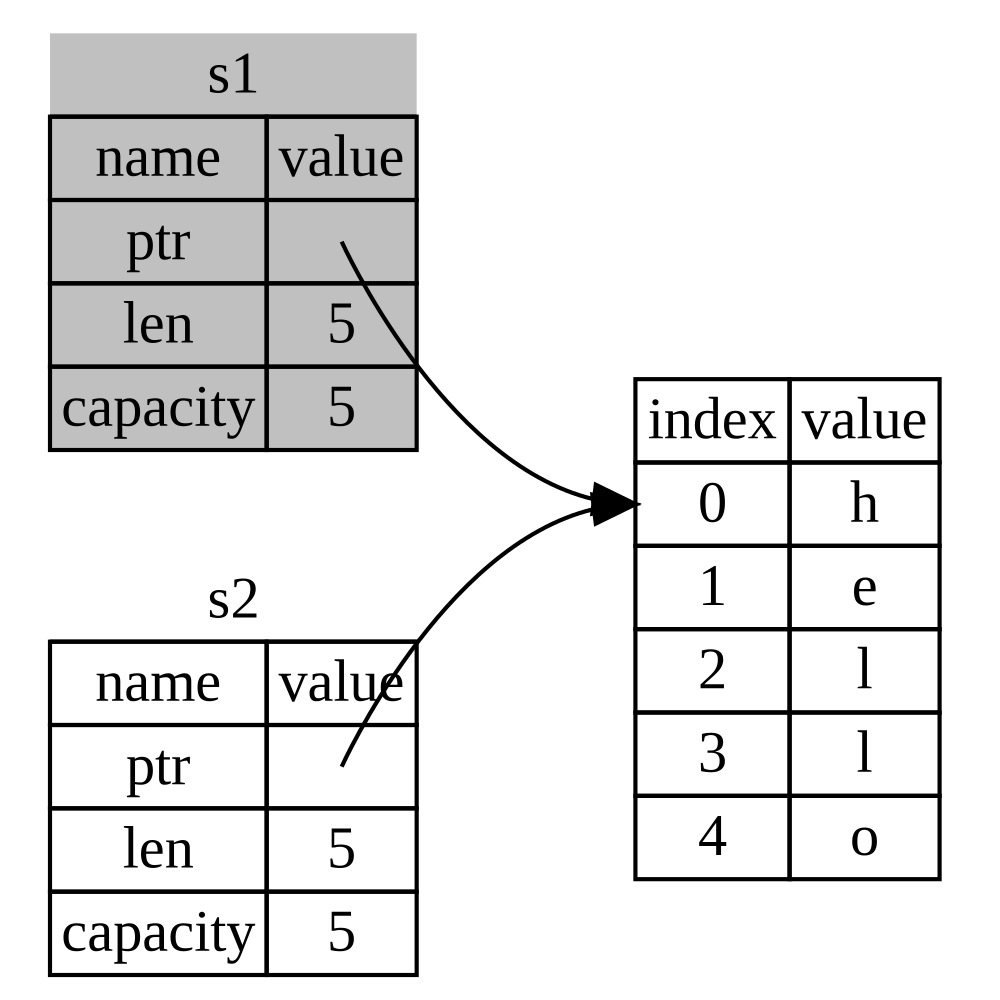
Reference output
[OEBPS/chapter-001.xhtml] Understanding Ownership Ownership is Rust’s most unique feature and has deep implications for the rest of the language. It enables Rust to make memory safety guarantees without needing a garbage collector, so it’s important to understand how ownership works. In this chapter, we’ll talk about ownership as well as several related features: borrowing, slices, and how Rust lays data out in memory.
[OEBPS/chapter-002.xhtml] What Is Ownership? Ownership is a set of rules that govern how a Rust program manages memory. All programs have to manage the way they use a computer’s memory while running. Some languages have garbage collection that regularly looks for no-longer-used memory as the program runs; in other languages, the programmer must explicitly allocate and free the memory. Rust uses a third approach: Memory is managed through a system of ownership with a set of rules that the compiler checks. If any of the ru
[OEBPS/chapter-003.xhtml] References and Borrowing The issue with the tuple code in Listing 4-5 is that we have to return the String to the calling function so that we can still use the String after the call to calculate_length , because the String was moved into calculate_length . Instead, we can provide a reference to the String value. A reference is like a pointer in that it’s an address we can follow to access the data stored at that address; that data is owned by some other variable. Unlike a pointer, a reference is
[OEBPS/chapter-004.xhtml] The Slice Type Slices let you reference a contiguous sequence of elements in a collection. A slice is a kind of reference, so it does not have ownership. Here’s a small programming problem: Write a function that takes a string of words separated by spaces and returns the first word it finds in that string. If the function doesn’t find a space in the string, the whole string must be one word, so the entire string should be returned. Note: For the purposes of introducing slices, we are assuming AS
[OEBPS/nav.xhtml] Understanding Ownership What Is Ownership? References and Borrowing The Slice Type
ok epub.info ownership.epub  4 chapters
title="Understanding Ownership" language=en chapters=4 images=7 words=7421
How a result is judged (1 check)
- python: code = "import html, posixpath, re, zipfile\nz = zipfile.ZipFile('ownership.epub')\nopf = re.search(r'full-path=\"([^\"]+)\"', z.read('META-INF/container.xml').decode()).group(1)\no = z.read(opf).decode()\nitems = {re.search(r'\\bid=\"([^\"]+)\"', t).group(1): re.search(r'\\bhref=\"([^\"]+)\"', t).group(1) for t in re.findall(r'<item\\b[^>]*>', o)}\ntext = ''\nfor i in re.findall(r'<itemref\\b[^>]*\\bidref=\"([^\"]+)\"', o):\n x = z.read(posixpath.join(posixpath.dirname(opf), items[i])).decode('utf-8', 'replace')\n text += ' ' + html.unescape(re.sub(r'<[^>]+>', ' ', re.sub(r'(?s)<head.*?</head>', ' ', x)))\ntext = re.sub(r'\\s+', ' ', text)\norder = ['Understanding Ownership', 'What Is Ownership?', 'References and Borrowing', 'The Slice Type', 'Summary']\nat = [text.find(s) for s in order]\nassert -1 not in at and at == sorted(at), f'chapters missing or out of order: {at}'\npics = [n for n in z.namelist() if n.lower().endswith(('.svg', '.png', '.jpg', '.jpeg'))]\nassert len(pics) >= 5, f'diagrams missing: {pics}'\nwords = len(text.split())\nnums = [int(n.replace(',', '')) for n in re.findall(r'\\d[\\d,]*', open('words.txt').read())]\nassert any(0.8 * words <= n <= 1.25 * words for n in nums), f'no word count near {words} in {nums}'\n"
Runs
Claude Opus 5.5Without deftPassed2026-11-15
- Time
- 66s
- New tokens
- 26.9k
- Total input
- 143.3k
- Output tokens
- 6.1k
- Commands
- 6
- Failed
- 0
Trace
ls -la; ls img | head -50; which pandoc; head -30 ch04-01-what-is-ownership.md; grep -n 'img\|<\|{{' ch04-0*.md | head -40output
total 120
drwxr-xr-x@   8 user  staff    256 Nov 14 19:37 .
drwx------@ 302 user  staff   9664 Nov 14 19:37 ..
drwxr-xr-x@   3 user  staff     96 Nov 14 19:37 .claude
-rw-r--r--@   1 user  staff    406 Nov 14 11:00 ch04-00-understanding-ownership.md
-rw-r--r--@   1 user  staff  25352 Nov 14 11:00 ch04-01-what-is-ownership.md
-rw-r--r--@   1 user  staff  10608 Nov 14 11:00 ch04-02-references-and-borrowing.md
-rw-r--r--@   1 user  staff  13237 Nov 14 11:00 ch04-03-slices.md
drwxr-xr-x@   9 user  staff    288 Nov 14 19:37 img
trpl04-01.svg
trpl04-02.svg
trpl04-03.svg
trpl04-04.svg
trpl04-05.svg
trpl04-06.svg
trpl04-07.svg
pandoc not found
## What Is Ownership?

_Ownership_ is a set of rules that govern how a Rust program manages memory.
All programs have to manage the way they use a computer’s memory while running.
Some languages have garbage collection that regularly looks for no-longer-used
memory as the program runs; in other languages, the programmer must explicitly
allocate and free the memory. Rust uses a third approach: Memory is managed
through a system of ownership with a set of rules that the compiler checks. If
any of the rules are violated, the program won’t compile. None of the features
of ownership will slow down your program while it’s running.

Because ownership is a new concept for many programmers, it does take some time
to get used to. The good news is that the more experienced you become with Rust
and the rules of the ownership system, the easier you’ll find
… 4934 more characters
ls ../listings 2>&1 | head -3; python3 -c "import markdown; print(markdown.__version__)"; python3 -c "import mistune; print(mistune.__version__)"; grep -c '{{#' ch04-0*.md; grep -n '^\[.*\]: ' ch04-0*.md | head -30; head -c 600 img/trpl04-01.svgoutput
ls: ../listings: No such file or directory
3.3.4
0.8.4
ch04-00-understanding-ownership.md:0
ch04-01-what-is-ownership.md:13
ch04-02-references-and-borrowing.md:16
ch04-03-slices.md:11
ch04-01-what-is-ownership.md:517:[data-types]: ch03-02-data-types.html#data-types
ch04-01-what-is-ownership.md:518:[ch8]: ch08-02-strings.html
ch04-01-what-is-ownership.md:519:[traits]: ch10-02-traits.html
ch04-01-what-is-ownership.md:520:[derivable-traits]: appendix-03-derivable-traits.html
ch04-01-what-is-ownership.md:521:[methods]: ch05-03-method-syntax.html#methods
ch04-01-what-is-ownership.md:522:[paths-module-tree]: ch07-03-paths-for-referring-to-an-item-in-the-module-tree.html
ch04-03-slices.md:331:[ch13]: ch13-02-iterators.html
ch04-03-slices.md:332:[ch6]: ch06-02-match.html#patterns-that-bind-to-values
ch04-03-slices.md:333:[strings]: ch08-02-strings.html#storing-utf-8-encoded-text-with-strings
ch04-03-slices.md:334:[deref-coercions]: ch15-02-deref.html#using-deref-coercions-in-functions-and-methods
<?xml version="1.0" encoding="UTF-8" standalone="no"?>
<!DOCTYPE svg PUBLIC "-//W3C//DTD SVG 1.1//EN"
 "http://www.w3.org/Graphics/SVG/1.1/DTD/svg11.dtd">
<!-- Generated by graphviz version 2.40.1 (20161225.0304)
 -->
<!-- Title: %3 Pages: 1 -->
<svg
 viewBox="0.00 0.00 1000.00 700.00" xmlns="http://www.w3.org/2000/svg" xmlns:xlink="http://www.w3.org/1999/xlink">
<g id="graph0" class="graph" transform="scale(4.1667 4.1667) rotate(0) translate(4 152)">
<title>%3</title>
<polygon fill="#ffffff
… 104 more characters
grep -n '{{#' ch04-0*.md | head -5; grep -ho '<[a-zA-Z/][a-zA-Z]*' ch04-0*.md | sort | uniq -c; grep -l -i 'script\|href=\|onload\|foreignObject' img/*.svg; ls -la img; grep -n 'Listing' ch04-02*.md | headoutput
ch04-01-what-is-ownership.md:120:{{#rustdoc_include ../listings/ch04-understanding-ownership/listing-04-01/src/main.rs:here}}
ch04-01-what-is-ownership.md:174:{{#rustdoc_include ../listings/ch04-understanding-ownership/no-listing-01-can-mutate-string/src/main.rs:here}}
ch04-01-what-is-ownership.md:216:{{#rustdoc_include ../listings/ch04-understanding-ownership/no-listing-02-string-scope/src/main.rs:here}}
ch04-01-what-is-ownership.md:248:{{#rustdoc_include ../listings/ch04-understanding-ownership/listing-04-02/src/main.rs:here}}
ch04-01-what-is-ownership.md:262:{{#rustdoc_include ../listings/ch04-understanding-ownership/no-listing-03-string-move/src/main.rs:here}}
  17 </Listing
   3 </a
   7 </span
  17 <Listing
   3 <a
   7 <img
   7 <span
total 128
drwxr-xr-x@ 9 user  staff    288 Nov 14 19:37 .
drwxr-xr-x@ 8 user  staff    256 Nov 14 19:37 ..
-rw-r--r--@ 1 user  staff   5284 Nov 14 11:00 trpl04-01.svg
-rw-r--r--@ 1 user  staff   7411 Nov 14 11:00 trpl04-02.svg
-rw-r--r--@ 1 user  staff  10097 Nov 14 11:00 trpl04-03.svg
-rw-r--r--@ 1 user  staff   7504 Nov 14 11:00 trpl04-04.svg
-rw-r--r--@ 1 user  staff   6942 Nov 14 11:00 trpl04-05.svg
-rw-r--r--@ 1 user  staff   6598 Nov 14 11:00 trpl04-06.svg
-rw-r--r--@ 1 user  staff   9670 Nov 14 11:00 trpl04-07.svg
3:The issue with the tuple code in Listing 4-5 is that we have to return the
15:<Listing file-name="src/main.rs">
21:</Listing>
70:Listing 4-6. Spoiler alert: It doesn’t work!
72:<Listing number="4-6" file-name="src/main.
… 235 more characters
sed -n 110,125p ch04-01-what-is-ownership.md; sed -n 236,242p ch04-01-what-is-ownership.md; grep -n '\](ch04\|: ch04\|#' ch04-0*.md | grep -v '^\S*:[0-9]*:#' | grep -v '{{' | head; cat ch04-00-understanding-ownership.md; grep -n '&[a-z]*;' ch04-0*.md | headoutput
```

The variable `s` refers to a string literal, where the value of the string is
hardcoded into the text of our program. The variable is valid from the point at
which it’s declared until the end of the current scope. Listing 4-1 shows a
program with comments annotating where the variable `s` would be valid.

<Listing number="4-1" caption="A variable and the scope in which it is valid">

```rust
{{#rustdoc_include ../listings/ch04-understanding-ownership/listing-04-01/src/main.rs:here}}
```

</Listing>

In other words, there are two important points in time here:
<!-- Old headings. Do not remove or links may break. -->

<a id="ways-variables-and-data-interact-move"></a>

#### Variables and Data Interacting with Move

Multiple variables can interact with the same data in different ways in Rust.
ch04-01-what-is-ownership.md:22:> ### The Stack and the Heap
ch04-01-what-is-ownership.md:517:[data-types]: ch03-02-data-types.html#data-types
ch04-01-what-is-ownership.md:521:[methods]: ch05-03-method-syntax.html#methods
ch04-03-slices.md:332:[ch6]: ch06-02-match.html#patterns-that-bind-to-values
ch04-03-slices.md:333:[strings]: ch08-02-strings.html#storing-utf-8-encoded-text-with-strings
ch04-03-slices.md:334:[deref-coercions]: ch15-02-deref.html#using-deref-coercions-in-functions-and-methods
# Understanding Ownership

Ownership is Rust’s most unique feature and has deep implications for the rest
of the language. It enables Rust to make memory safety guarantees without
needing a garb
… 307 more characters
mkdir -p $TMPDIR/build && cat > $TMPDIR/build/make_epub.py <<'EOF' import re, sys, os, uuid, zipfile, html, datetime import xml.dom.minidom import markdown SRC = os.getcwd() CHAPTERS = ["ch04-00-understanding-ownership.md", "ch04-01-what-is-ownership.md", "ch04-02-references-and-borrowing.md", "ch04-03-slices.md"] IMGS = sorted(f for f in os.listdir(os.path.join(SRC, "img")) if f.endswith(".svg")) local = {c[:-3] + ".html": c[:-3] + ".xhtml" for c in CHAPTERS} missing = [] def attr(tag, name): m = re.search(name + r'="([^"]*)"', tag) return m.group(1) if m else None def pre(text): def listing_open(m): tag = m.group(0); out = [] fn = attr(tag, "file-name") if fn: out.append(f'<p class="filename">Filename: {html.escape(fn)}</p>\n') stack.append((attr(tag, "number"), attr(tag, "caption"))) return "".join(out) def listing_close(m): num, cap = stack.pop() if num: c = f"Listing {num}" + (f": {cap}" if cap else "") return md_inline_caption(c) return "" def include(m): path = m.group(2).split(":")[0] missing.append(path) return f"// [source not available: {path.replace('../', '')}]" stack = [] text = re.sub(r"\{\{#(rustdoc_include|include)\s+([^}]+)\}\}", include, text) text = re.sub(r"<Listing\b[^>]*>", listing_open, text) text = re.sub(r"</Listing>", listing_close, text) return text def md_inline_caption(c): inner = markdown.markdown(c)[3:-4] return f'<p class="caption">{inner}</p>' def fix_links(h): def repl(m): href, body = m.group(1), m.group(2) page, _, frag = href.partition("#") if page in local: return f'<a href="{local[page]}{"#"+frag if frag else ""}">{bo … 4282 more charactersoutput
words 7347 missing includes 40
7347
Archive:  ownership.epub
  Length      Date    Time    Name
---------  ---------- -----   ----
       20  01-01-1980 00:00   mimetype
      242  11-14-2026 19:38   META-INF/container.xml
     1634  11-14-2026 19:38   OEBPS/content.opf
      674  11-14-2026 19:38   OEBPS/nav.xhtml
      511  11-14-2026 19:38   OEBPS/style.css
      739  11-14-2026 19:38   OEBPS/ch04-00-understanding-ownership.xhtml
    27774  11-14-2026 19:38   OEBPS/ch04-01-what-is-ownership.xhtml
    12214  11-14-2026 19:38   OEBPS/ch04-02-references-and-borrowing.xhtml
    15001  11-14-2026 19:38   OEBPS/ch04-03-slices.xhtml
     5284  11-14-2026 11:00   OEBPS/img/trpl04-01.svg
     7411  11-14-2026 11:00   OEBPS/img/trpl04-02.svg
    10097  11-14-2026 11:00   OEBPS/img/trpl04-03.svg
     7504  11-14-2026 11:00   OEBPS/img/trpl04-04.svg
     6942  11-14-2026 11:00   OEBPS/img/trpl04-05.svg
     6598  11-14-2026 11:00   OEBPS/img/trpl04-06.svg
     9670  11-14-2026 11:00   OEBPS/img/trpl04-07.svg
---------                     -------
   112315                     16 files
104:which it’s declared until the end of the current scope. Listing 4-1 shows a
105-program with comments annotating where the variable <code>s</code> would be valid.</p>
106-<pre><code class="language-rust">// [source not available: listings/ch04-understanding-ownership/listing-04-01/src/main.rs]
107-</code></pre>
--
182:from Listing 4-1 using a <code>String</code> instead of a string literal:</p>
183-<p
… 790 more characters
The book builds, but listing captions end up in the wrong places (I matched opening and closing tags in the wrong order). Fixing that now, and I'll leave the placeholder lines out of the word count.
cd $TMPDIR/build && sed -i '' 's/num, cap = stack.pop()/num, cap = stack.pop(0)/' make_epub.py && sed -i '' 's| plain = re.sub(r"<!--.\*?-->", " ", body, flags=re.S)| plain = re.sub(r"<!--.*?-->\|// \\[source not available: [^\\]]*\\]", " ", body, flags=re.S)|' make_epub.py && grep -n 'stack.pop\|plain = re' make_epub.py && cd - >/dev/null && python3 -I $TMPDIR/build/make_epub.py && unzip -p ownership.epub OEBPS/ch04-01-what-is-ownership.xhtml | grep -n -B3 'class="caption">Listing' | head -20output
24:        num, cap = stack.pop(0)
85:    plain = re.sub(r"<!--.*?-->|// \[source not available: [^\]]*\]", " ", body, flags=re.S)
words 7147 missing includes 40
105-program with comments annotating where the variable <code>s</code> would be valid.</p>
106-<pre><code class="language-rust">// [source not available: listings/ch04-understanding-ownership/listing-04-01/src/main.rs]
107-</code></pre>
108:<p class="caption">Listing 4-1: A variable and the scope in which it is valid</p>
--
206-Listing 4-2 shows an example using an integer.</p>
207-<pre><code class="language-rust">// [source not available: listings/ch04-understanding-ownership/listing-04-02/src/main.rs]
208-</code></pre>
209:<p class="caption">Listing 4-2: Assigning the integer value of variable <code>x</code> to <code>y</code></p>
--
374-
375-<pre><code class="language-rust">// [source not available: listings/ch04-understanding-ownership/listing-04-03/src/main.rs]
376-</code></pre>
377:<p class="caption">Listing 4-3: Functions with ownership and scope annotated</p>
--
388-
389-<pre><code class="language-rust">// [source not available: listings/ch04-understanding-ownership/listing-04-04/src/main.rs]
390-</code></pre>
391:<p class="caption">Listing 4-4: Transferring ownership of return values</p>
--
I made `ownership.epub` and wrote the word count, **7147**, to `words.txt`. One big gap: **none of the Rust code examples are in the book.** Each code block shows a placeholder line instead, such as `// [source not available: listings/.../main.rs]`. **Missing code:** the chapters don't contain their code. They pull it in with `{{#include ...}}` / `{{#rustdoc_include ...}}` lines that point to a `../listings/` folder. That folder isn't in this directory, so 40 code blocks (and the compiler output examples) are empty. If you can add the `listings/` folder, I can rebuild the book with the real code in place. **What the book contains:** - The four chapters in the order you gave, with a table of contents. - All seven diagrams from `img/` (`trpl04-01.svg` to `trpl04-07.svg`), each with its figure caption. - Listing captions ("Listing 4-1: …") and filename labels, converted from the chapters'
Output
Its files were not kept in this run. The last line of the trace is its own report.
Claude Opus 5.5With deft, skill installedPassedRead the skillUsed deft2026-11-15
- Time
- 40s
- New tokens
- 17.7k
- Total input
- 164.0k
- Output tokens
- 2.8k
- Commands
- 8
- Failed
- 1
Trace
Loaded the deft skill
ls -la; ls img | head -50; which pandoc deft (exit 1)output
Exit code 1
total 120
drwxr-xr-x@   8 user  staff    256 Nov 14 19:37 .
drwx------@ 302 user  staff   9664 Nov 14 19:37 ..
drwxr-xr-x@   4 user  staff    128 Nov 14 19:37 .claude
-rw-r--r--@   1 user  staff    406 Nov 14 11:00 ch04-00-understanding-ownership.md
-rw-r--r--@   1 user  staff  25352 Nov 14 11:00 ch04-01-what-is-ownership.md
-rw-r--r--@   1 user  staff  10608 Nov 14 11:00 ch04-02-references-and-borrowing.md
-rw-r--r--@   1 user  staff  13237 Nov 14 11:00 ch04-03-slices.md
drwxr-xr-x@   9 user  staff    288 Nov 14 19:37 img
trpl04-01.svg
trpl04-02.svg
trpl04-03.svg
trpl04-04.svg
trpl04-05.svg
trpl04-06.svg
trpl04-07.svg
pandoc not found
deft
D=deft; $D md; $D md epub --help 2>&1 || $D md to-epub --help; $D epub; grep -n 'img/' *.md | headoutput
deft md - commands (input -> output)
  from-docx  doc -> md      Convert to Markdown, keeping headings, lists and tables
  from-html  html -> md     Convert to Markdown; scripts and styles are dropped
  to-docx    md -> docx     Write a Word document with headings, lists, tables, images
  to-epub    md... -> epub  Make an e-book; each top-level heading starts a chapter
  to-html    md -> html     Render to a styled HTML page, or --fragment
  to-pdf     md -> pdf      Typeset Markdown as PDF
  toc        md -> md       Insert a table of contents from the headings
More: deft md <command> --help
deft md to-epub - Make an e-book; each top-level heading starts a chapter
Same as: deft epub from-md · deft convert

Usage: deft md to-epub <md>... [-o <epub|dir>] [options]
In: md (all together, in order)   Out: epub (default <name>.book.<ext>)

Options:
  --title <text>               Book title (default: first heading)
  --author <text>              Author
  --lang <text>                Language code (default en)
Common: -o --force --dry-run --json -j   (deft help common)

Examples:
  deft md to-epub notes.md --author Ada -o notes.epub

Result fields: chapters
deft epub - commands (input -> output)
  info     epub -> report  Title, author, language, chapters, images, words
  from-md  md... -> epub   Make an e-book; each top-level heading starts a chapter
  to-md    epub -> md      Convert the whole book to Markdown
  to-pdf   epub -> pdf     Typeset the book as PDF
  to-text  epub -> t
… 772 more characters
Images are raw HTML `<img>` tags; I'll build and then verify they got embedded.
D=deft; $D md to-epub ch04-00-understanding-ownership.md ch04-01-what-is-ownership.md ch04-02-references-and-borrowing.md ch04-03-slices.md -o ownership.epub; $D epub info ownership.epub --json; unzip -l ownership.epuboutput
ok md.to-epub 4 files -> ownership.epub  4 chapters  0.01s
warning: 17 raw HTML tags or attributes dropped: e-book readers refuse them
{"v":1,"ok":true,"op":"epub.info","items":[{"ok":true,"inputs":["ownership.epub"],"outputs":[],"facts":{"title":"Understanding Ownership","author":null,"language":"en","chapters":4,"images":7,"words":7421},"warnings":[]}],"elapsed_ms":4}
Archive:  ownership.epub
  Length      Date    Time    Name
---------  ---------- -----   ----
       20  01-01-1980 00:00   mimetype
      223  01-01-1980 00:00   META-INF/container.xml
     1369  01-01-1980 00:00   OEBPS/content.opf
      496  01-01-1980 00:00   OEBPS/nav.xhtml
      633  01-01-1980 00:00   OEBPS/chapter-001.xhtml
    27279  01-01-1980 00:00   OEBPS/chapter-002.xhtml
    12092  01-01-1980 00:00   OEBPS/chapter-003.xhtml
    14603  01-01-1980 00:00   OEBPS/chapter-004.xhtml
     5284  01-01-1980 00:00   OEBPS/trpl04-01.svg
     7411  01-01-1980 00:00   OEBPS/trpl04-02.svg
    10097  01-01-1980 00:00   OEBPS/trpl04-03.svg
     7504  01-01-1980 00:00   OEBPS/trpl04-04.svg
     6942  01-01-1980 00:00   OEBPS/trpl04-05.svg
     6598  01-01-1980 00:00   OEBPS/trpl04-06.svg
     9670  01-01-1980 00:00   OEBPS/trpl04-07.svg
---------                     -------
   110221                     15 files
unzip -p ownership.epub 'OEBPS/chapter-*.xhtml' | grep -o '<img[^>]*>' | head -3; grep -c '<' *.md; grep -on '<[a-zA-Z][^ >]*' *.md | grep -v img | sort -t: -k3 | awk -F: '{print $3}' | sort | uniq -coutput
ch04-00-understanding-ownership.md:0
ch04-01-what-is-ownership.md:35
ch04-02-references-and-borrowing.md:15
ch04-03-slices.md:22
  17 <Listing
   3 <a
   7 <span
unzip -p ownership.epub OEBPS/chapter-002.xhtml | grep -n -i -E 'svg|Listing 4-1|caption' | head; grep -n -A2 '<Listing' ch04-01-what-is-ownership.md | head -8output
101:which it’s declared until the end of the current scope. Listing 4-1 shows a
177:from Listing 4-1 using a <code>String</code> instead of a string literal:</p>
223:string data on the heap, byte by byte." src="trpl04-01.svg" class="center" style="width: 50%;"/></p>
224:<p><span class="caption">Figure 4-1: The representation in memory of a <code>String</code>
236:stack, respectively, and both pointing to the same string data on the heap." src="trpl04-02.svg" class="center" style="width: 50%;"/></p>
237:<p><span class="caption">Figure 4-2: The representation in memory of the variable
244:and each points to its own copy of string data on the heap." src="trpl04-03.svg" class="center" style="width: 50%;"/></p>
245:<p><span class="caption">Figure 4-3: Another possibility for what <code>s2 = s1</code> might
273:access the heap data." src="trpl04-04.svg" class="center" style="width:
275:<p><span class="caption">Figure 4-4: The representation in memory after <code>s1</code> has
117:<Listing number="4-1" caption="A variable and the scope in which it is valid">
118-
119-```rust
--
245:<Listing number="4-2" caption="Assigning the integer value of variable `x` to `y`">
246-
247-```rust
--
unzip -p ownership.epub OEBPS/chapter-002.xhtml | grep -c 'A variable and the scope'; grep -h '<Listing' *.md | head -3; grep -c '</Listing>' *.mdoutput
0
<Listing number="4-1" caption="A variable and the scope in which it is valid">
<Listing number="4-2" caption="Assigning the integer value of variable `x` to `y`">
<Listing number="4-3" file-name="src/main.rs" caption="Functions with ownership and scope annotated">
ch04-00-understanding-ownership.md:0
ch04-01-what-is-ownership.md:5
ch04-02-references-and-borrowing.md:6
ch04-03-slices.md:6
set -e; W=$(mktemp -d "$TMPDIR/epub.XXXX"); cp -R img "$W/"
for f in ch04-00-understanding-ownership.md ch04-01-what-is-ownership.md ch04-02-references-and-borrowing.md ch04-03-slices.md; do
perl -pe 'if(/^<Listing(.*)>\s*$/){my $a=$1; ($n)=$a=~/number="([^"]*)"/; ($c)=$a=~/caption="([^"]*)"/; ($fn)=$a=~/file-name="([^"]*)"/; $cap=defined $n ? "Listing $n".(defined $c?": $c":"") : (defined $c?$c:""); $_ = defined $fn ? "Filename: $fn\n" : "\n"} elsif(/^<\/Listing>\s*$/){$_ = $cap ne "" ? "*$cap*\n" : "\n"; $cap=""}' "$f" > "$W/$f"; done
grep -c 'Listing' "$W"/*.md | head; D=deft
$D md to-epub "$W"/ch04-00-understanding-ownership.md "$W"/ch04-01-what-is-ownership.md "$W"/ch04-02-references-and-borrowing.md "$W"/ch04-03-slices.md -o ownership.epub --force
$D epub info ownership.epub --json
output
<tmp>
<tmp>
<tmp>
<tmp>
ok md.to-epub 4 files -> ownership.epub  4 chapters  0.01s
{"v":1,"ok":true,"op":"epub.info","items":[{"ok":true,"inputs":["ownership.epub"],"outputs":[],"facts":{"title":"Understanding Ownership","author":null,"language":"en","chapters":4,"images":7,"words":7550},"warnings":[]}],"elapsed_ms":5}
unzip -p ownership.epub OEBPS/chapter-002.xhtml | grep -o 'Listing 4-1: [^<]*'; echo 7550 > words.txt; cat words.txtoutput
Listing 4-1: A variable and the scope in which it is valid
7550
I made `ownership.epub` from the four chapters in the order you gave, and `words.txt` contains **7550**. - **Chapters:** the book has 4 chapters. Its title, "Understanding Ownership", comes from the first heading. - **Diagrams:** all 7 from `img/` (`trpl04-01.svg` to `trpl04-07.svg`) are inside the book, each with its figure caption. - **Listing captions:** the first build dropped the 17 mdBook `<Listing>` tags, and the code-listing captions went with them. I changed those tags to plain Markdown in temporary copies of the chapters and rebuilt from the copies. Each code listing now has its caption below it (for example, "Listing 4-1: A variable and the scope in which it is valid") and, where the tag names one, a "Filename: …" line above it. Your original `.md` files are unchanged. - **Word count:** 7550 is the count the `deft` file tool reports for the finished book. It includes the capt
Output
Its files were not kept in this run. The last line of the trace is its own report.